Showing posts with label Shared Use Nonmotorized. Show all posts

Wednesday, July 3, 2019

Trails, greenways are important community assets


Florida Weekly 'Outdoors' column, June 19, 2019
danMOSER
bikepedmoser@gmail.com

A sign at Colonial Boulevard and Ortiz Avenue marks a trailhead park and linear trail. DAN MOSER / FLORIDA WEEKLY
Being an admitted hyper-critic of our environment for pedestrians and bicyclists, I can still nonetheless recognize the good things happening and understand the potential we can achieve.

For example, at a recent Healthy Lee steering committee meeting, the keynote speaker was Dale Allen, president of Florida Greenways and Trails Foundation, an organization that wields significant sway in our state for projects and funding related to the foundation’s namesake. This is not Mr. Allen’s first visit to Southwest Florida or his only presentation to a room full of heavy-hitters. Mr. Allen’s message was to convince committee members that embracing trails and greenways for non-motorized uses benefits everyone in many ways.

Before getting into the advantages, I’d like to define the kind of trail I’m writing about: paved, non-motorized shared-use paths, 10 feet to 14 feet wide, preferably not adjacent to a roadway but if so, separated with a significant buffer. John Yarbrough Linear Park Trail is an example.

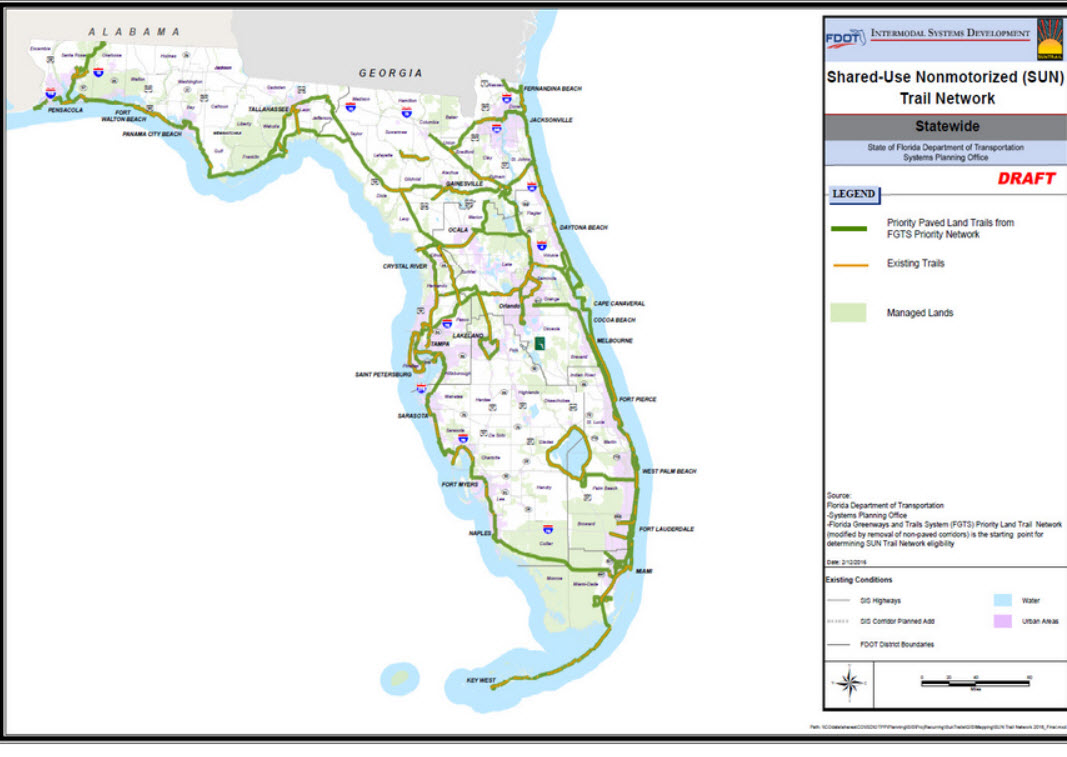
 Trails like these exist in much of Florida and include networks such as SUNtrail (Shared-Use, Non-motorized Trails). SUNtrail traverses the state from Pensacola and Jacksonville to Key West and includes many inland counties. One important segment of it which is soon to be complete is the Coast-to-Coast Regional Connector that runs from the Tampa Bay area to the Space Coast.

There are also a number of Railsto Trails facilities throughout Florida, including one in Lee County on Gasparilla Island. As well, parts of the East Coast Greenway and U.S. Bicycle Route System are within Florida.

So, trails are no stranger to our state, although ones of significant distance and substance are relatively rare here in Southwest Florida. We’re missing out on the many benefits they represent.

Naysayers who believe trails are a waste of money and serve only a small segment of those who pay for them overlook their multitude of economic, safety, health, quality of life, transportation and environmental benefits. Some benefits are obvious, such as improved health among users and providing transportation options other than driving, something that benefits both the individual taking advantage of it and the overall environment by keeping cars off the road.

Transportation equity and safety for those who can’t afford or otherwise don’t have access to motor vehicles is another advantage. For those only looking at dollars, the purely economic pluses are many, from increased property values near trails to savings on healthcare and transportation for society and individuals.

Regarding job creation, a high quality of life is a key factor necessary to attract skilled employees when businesses are opening or relocating; nearby access to trails is one of the elements known to improve that factor. As for small businesses, many mom-and-pops — from bike shops to cafés — spring up along trails, especially in rural areas.

And lower income areas that are frequently where rail corridors exist — whether active or abandoned — are positively impacted once a trail is established with business growth, lowered crime rates and improved transportation equity.

The Florida Department of Environmental Protection’s “Florida’s Greenways and Trails System Plan, 2019-2023” includes a detailed overview of the many benefits as well as excellent maps and other useful information. It can be found on their website at www.floridadep.gov.

There’s really no downside to having a robust network of trails as part of our infrastructure. But misinformation and misperception too often equate to NIMBYism, a phenomenon that has resulted in shooting down trails and other bike/ped infrastructure on a regular basis. And elected representatives and other government officials who are not well educated about the value of them sometimes look only at the cost or cave in to NIMBYism rather than examining the benefits.

But from what I witnessed when Mr. Allen came to town and made the case for including trails as an integral part of our community, I’m hopeful that our elected officials and others who have influence make that a reality. One example is that there’s agreement among all the pertinent jurisdictions to buy out the lease Seminole Gulf Railroad has with CSX so the rail corridor that runs down the middle of Lee County can be turned into a rail-to-trail or even a rail-with-trail that includes a light passenger train. John Yarbrough Linear Park/Trail runs adjacent to over five miles of that, with another two-mile segment to be added to Hanson Street. Extending it to the Collier County line would go a long way in completing our segment of SUNtrail. Wouldn’t that be a great asset for residents and tourists alike?

To learn about this topic and more, visit bikewalklee.blogspot.com and www.streetsaliveswfl.org.¦


- Dan Moser is a long-time bicycle/pedestrian advocate and traffic safety professional who cycles, runs and walks regularly for transportation, recreation and fitness. Contact him at bikepedmoser@gmail.com and 334-6417. 

For Lee County cycling and tri events visit Caloosa Riders Bicycle Club (caloosariders.org); Florida Mudcutters (mudcutters.org); and SW Florida Biking Meetup Group (meetup.com/Biking-SWFL). The Florida Bicycle Association (floridabicycle.org) is your source for statewide happenings. BikeWalkLee’s blog site has all the information you’ll need to stay abreast of advocacy efforts in Southwest Florida as well as statewide and nationally.




Wednesday, February 13, 2019

Sidewalks are not shared use paths


Florida Weekly 'Outdoors' column, February 13, 2019
danMOSER
bikepedmoser@gmail.com

This FDOT side path on Cleveland Avenue is clearly a sidewalk intended for pedestrians. DAN MOSER / FLORIDA WEEKLY
Just when it appeared that the Florida Department of Transportation had transformed itself from the auto-centric roadbuilding agency of the past to one that had finally embraced Complete Streets, it backslid in a big way. Although it’s been under the radar for much of the general public and the media, a decision made in Tallahassee last year has drastically changed the policy related to side-paths construction and maintenance.

The new policy requires local governments to fully maintain any side path on FDOT roads that are meant for more than just pedestrians, meaning shared use paths over 8 feet wide and constructed of asphalt will no longer be built on state roads unless locals take over all aspects of maintenance (storm water management, surface repair and replacement, and other elements like railings and fences), an expense most governments will not agree to absorb.

Worse yet, FDOT made this major decision without any input from the many jurisdictions throughout the state that the policy has already begun to impact, which is totally contrary to a key principles of Complete Streets.

Like many states’ transportation departments, FDOT’s old motto was “we build them to ’em and through ’em,” referring to the way they operated without taking into consideration how roads would change communities or what local governments’ wishes were. The scars of this mindset are obvious when visiting just about any town in Florida where “main street” is or was the state highway ripping through its central business district, meaning there’s little chance of it being pedestrian-friendly unless locals forced it to be rerouted or redesigned.

Fort Myers is one such community that was able to convince FDOT to change the nature of SR 80 (Palm Beach Boulevard and Second Street) and SR 82 (Martin Luther King Boulevard). To FDOT’s credit, it recently put into place its own Complete Streets policy which includes much more bike/ped-friendly designs on surface roads (i.e., non-interstates and turnpike). Cleveland Avenue, from Winkler Avenue to downtown Fort Myers, should be a good example of this change of approach once work is completed.

However, this latest side path policy change will have many consequences that are clearly not complying with its own Complete Streets policy, a policy that first and foremost includes input from as many sources as possible, but especially those being directly impacted.

The effects of FDOT’s regression are significant. Even when buffered bike lanes are provided, narrow, concrete sidewalks rather than wider asphalt paths will reduce the number of folks who would use their bikes for transportation or to recreate, meaning more motor vehicles on the roads (motor vehicle travel lanes are much more expensive to build and maintain than SUPs). It will also severely impact the statewide trail system by creating many gaps because most jurisdictions simply will not take on maintenance of another jurisdiction’s right-of-way. Narrow concrete sidewalks do not meet the standards for the statewide trail network. And many funding sources specific to the statewide system or trails in general will be off the table due to adjacent segments on state roads not meeting standards, thus there would be no continuity. Already affected locally are SR 80 east of I-75, SR 78 (Bayshore Road) from just west of I-75 to SR 31, and SR 31 (the road to Babcock, which will have its own trail network open to the public).

At this point there seems to be little willingness by FDOT to reconsider its unilateral decision. For those local governments that have SUPs included on bike/ ped master plans or otherwise expected SUPs have two bad choices: let FDOT reduce them to sidewalks (as Lee County has already done) or agree to an unexpected, unknown, and unfair burden by taking on all maintenance expenses. These choices would never be required for elements of FDOT’s network that serve motor vehicles. To learn more about this and similar matters visit bikewalklee.blogspot.com. ¦

 
- Dan Moser is a long-time bicycle/pedestrian advocate and traffic safety professional who cycles, runs and walks regularly for transportation, recreation and fitness. Contact him at bikepedmoser@gmail.com and 334-6417. 

For Lee County cycling and tri events visit Caloosa Riders Bicycle Club (caloosariders.org); Florida Mudcutters (mudcutters.org); and SW Florida Biking Meetup Group (meetup.com/Biking-SWFL). The Florida Bicycle Association (floridabicycle.org) is your source for statewide happenings. BikeWalkLee’s blog site has all the information you’ll need to stay abreast of advocacy efforts in Southwest Florida as well as statewide and nationally.


Wednesday, March 29, 2017

BikeWalkLee: Suggestions on sharing the path

BWL Column
The News-Press, 3/30/2017

by Ken Gooderham

We’ve addressed the issues of sharing the road. What about sharing the path… or lane or shoulder or sidewalk?

That’s one of the issues right there: Each one of those travelways may require a different approach during the interaction of cyclist and pedestrian, because each has a different set of rules surrounding use. A shared-use path, by its very name, states its mission – a shared space for cyclists and pedestrians – while a sidewalk also makes its purposes clear – a place to walk first, with other uses falling in behind that.

Then you have a bike lane, which may or may not be for pedestrians depending on the adjacent facilities, and a shoulder, which really is a place for cars to pull out of the traffic lane but is also used for cycling, walking and who knows what else.

Taking these differences in stride, let’s look at how cyclists and pedestrians can work to share their common space – whatever it is called.


Cyclists:
  • Warn walkers (and other cyclists) when you’re passing them, and give them enough room (three feet works for cars, why not bikes as well?).
  • Pedestrians always have the right of way… no exceptions.
  • Stay in your lane… which may depend on which kind of path you’re on. If you’re on a shoulder, ride with traffic. If you’re on a shared-use path, stay to the right as though you were a vehicle. If you’re on a sidewalk… well, go with the flow, but be prepared to be invisible to many drivers.
  • If you need to take a break, don’t just stop… move out of the way so others can get by.
  • Be realistic in your expectations depending on where you ride. If you absolutely must have a hard, fast ride to make your day worthwhile, don’t expect to find that on a shared-use-path. Slower traffic means a slower pace for all… and if that’s not to your liking, then get out on the road and leave the path to the more patient.

Pedestrians:
  • Pay attention to your surroundings. Just because you have the right of way doesn’t mean you’re always going to get it – and, as the most vulnerable users, you have the most to lose.
  • Keep your pets on a short lease… both for their protection and for everyone else.
  • Keep your kids on a short lease, too (maybe not literally, but figuratively). Keep an eye on them, make sure they know how to share the path and avoid dangerous situations.
  • Walk facing traffic, particularly on shoulders… but it’s usually a good plan wherever you are.
  • Make room for your fellow path users. Don’t walk three abreast so you can chat if the path is barely wide enough already. Sharing the path is literal, so act accordingly. (This counts for cyclists as well… ride side by side only when there’s enough room to do so safely.)

Everyone:
  • Be visible, day or night. Bright colors and bright lights are a bright idea.
  • Be predictable. Act like you’re supposed to, because that is what other users are expecting.
  • Be prepared for the unexpected from everyone… vehicles, bikes, even fellow pedestrians.
  • Be careful. You can get away with doing something stupid only so many times before the odds stack against you.
  • Be courteous. There’s plenty of room for everyone, and being pleasant helps make the experience pleasant for all.

Right now, our bike/walk facilities are probably at the maximum capacity sometimes, as more people and nice weather lures more folks out to bike, run or walk. There’s plenty of room for everyone, as long as we all work to get along.


A million reasons to move

Tomorrow marks the end of this year Million Mile Movement, Healthy Lee’s challenge to county residents to track their actions and hit a million miles in three months.

If you joined in and added your exercise to the total, good for you. If not… well, if you were moving but just not counting, OK; if you weren’t moving, not OK.

Either way, you don’t need a challenge to make your movement count. If you picked up the pace to help the county make its goal, don’t let the end of the challenge be the end of your movement. Commit to be fit and keep your exercise habit alive into April and beyond.

And if you didn’t accept this challenge, it’s never too late to set new goals for yourself anyway. Start walking, running or biking… or find another activity (or more than one) that motivates you to move.

Then, next year you can add your daily actions to help Healthy Lee hit the million mile mark again.


Ready to ride or run?

Run? A slight gap in the race schedule this weekend, but the 5Ks resume April 8 with a dog-friendly Fast and Furriest at Hammond Stadium in Fort Myers, followed by an Eggs and Ears 5K in Lakes Park, Fort Myers, and a Wellfit Girls To(tu) Peru 5K and yoga event in North Collier Regional Park on April 15. Details at 3dracinginc.com or gcrunner.org.

Ride? Critical Mass ride tomorrow night (Cape Coral), April 7 (Fort Myers) and April 8 (Sanibel). All are at night to bring your lights (and helmet); details at http://www.meetup.com/Biking-SWFL/events/. For something longer head south to the 10th annual Everglades Ride on April 2, with a variety of distances and surfaces (evergladesrogg.org).

Both? Try a different kind of tri on Sunday, April 2, with the Lake Avalon Reverse Triathlon, Duathlon & 5K, Naples (eliteevents.org)


TELL US ABOUT YOUR RIDE:
Have a favorite route you like to bike, or a unique walk you’d like to share with others? Tell us about it at info@bikewalklee.org, and maybe we can feature it in an upcoming column.

# # #

Ken Gooderham writes this on behalf of BikeWalkLee, a community coalition raising public awareness and advocating for complete streets in Lee County — streets that are designed, built, operated and maintained for safe and convenient travel for all users: pedestrians, bicyclists, motorists, and transit riders of all ages and abilities. Information, statistics and background online at www.BikeWalkLee.org.

Wednesday, October 12, 2016

Cape Receives $1.8 Million SUN Trail Grant to Design Multi-Use Trail in North Cape

Vision of Florida interconnected trail system
The City of Cape Coral announced today that it has received an $1.8 million FDOT grant to design a multi-use bicycle and pedestrian trail in North Cape Coral along Kismet Parkway. The trail will be part of the Florida SUNTrail, a statewide system of paved multi-use trails for bicyclists and pedestrians, physically separated from vehicular traffic.

The new trail will be a welcome addition to the existing bike/ped facilities in the Cape, in particular for residents of the Northern parts of the city. It will expand the opportunities for safe outdoor exercise and recreation in the area.

The trail will eventually connect Cape Coral to the statewide SUN Trail network of bicycle pedestrian trails, enhancing the city's profile as a tourist destination and its image as a bike/pedestrian friendly community.

BikeWalkLee was an early supporter of SUN Trail and has submitted letters of support. Our annual letter to the Lee Legislative Delegation for the past four years has made bike tourism and the statewide network of bike/ped paths, now called SUN Trail, one of our top priorities. Congratulations to the City of Cape Coral and the volunteers of Cape Coral Bike Ped who have been instrumental in this grant application.


From the 10/12 Cape Coral press release:
‘The City of Cape Coral has received a $1.8 million grant from the Florida Department of Transportation for the preliminary engineering and design of a multi-use trail along Kismet Parkway in the north Cape. The Cape's individual trail project was one of 45 projects to receive funding for bicycle and pedestrian trail expansion in Florida through the new Shared Use Nonmotorized (SUN) Trail Program. FDOT awarded $44.4 million in statewide grants in the first year of the program.

"Cape Coral continues to achieve success in obtaining grant funds to help with our goal of expanding bicycle and pedestrian opportunities throughout the city," said Connie Barron, Public Affairs Manager for the City. "This project along Kismet Parkway will provide a signature destination for recreational activity in the north Cape."

The multi-use trail will be on the north side of Kismet Parkway from Del Prado Boulevard west to El Dorado Boulevard, and passing by the City's future Festival Park. The trail will continue on the west side of El Dorado south to Van Buren Parkway, and then on the north side of Van Buren Parkway west to Burnt Store Road. The 12-foot-wide trail spans about seven miles and potentially could include exercise components similar to the linear park along Del Prado Boulevard.

The Cape Coral Bike-Ped group was instrumental in the successful application for grant funding from the SUN Trail Program. The volunteer group continues to work in partnership with the City to advance the goal of developing a bicycle and pedestrian friendly Cape Coral.


Lee Co. segment of SW Coastal Regional Trail
From the 10/11 FDOT press release:

‘All of the selected projects are in the identified SUN Trail network, which consists of the developing statewide system of paved multi-use trails for bicyclists and pedestrians, physically separated from vehicular traffic.

FDOT Secretary Jim Boxold said, “This initial SUN Trail funding will provide safer opportunities for bicyclists and pedestrians, advance the completion of the state trail system and enhance the state’s partnership with local communities throughout Florida.”

Twenty-two of the funded projects help to advance two major regional trails systems selected as priorities by the Florida Greenways and Trails Council. Five of these are part of the Coast to Coast Connector, a 250-mile trail system linking the Gulf and Atlantic coasts through Central Florida, and 17 are part of the St. Johns River Sea Loop, a 270-mile trail system that will link together several communities including St. Augustine, Daytona Beach, Titusville, DeLand and Palatka. 23 projects are for individual trail segments throughout the rest of the state.

The SUN Trail Program was established during the 2015 legislative session. More information about the program can be found at floridasuntrail.com.’