Wednesday, July 13, 2016

Dan Moser column: be the eyes of public works for safer sidewalks and pathways

When you are running, walking or cycling, you may encounter a blocked sidewalk (garbage cans), low hanging tree branch or a pothole in the right of way. In this week's Dan Moser column in Florida Weekly, suggestions on how get the issues resolved. Click here for one-pager with all who/what/when/how to report (keep this handy).
 
danMOSER
bikepedmoser@gmail.com

Every time we turn the faucet handle and water flows we should be thankful for our public works departments.

The same goes for having the ability to walk, ride our bikes, or drive our cars on safe facilities, even though (generally through no fault of the public works folks) motorists clearly have more for which to be thankful.

There’s no doubt that the women and men who maintain and operate our public infrastructure do a lot with limited financial resources. But because funds are so limited they can use our assistance by being their eyes and directing them to things needing to be addressed that they may overlook.

With summer and its frequent rain upon us we’re sure to deal with standing water and overgrown vegetation that creates problems for runners, walkers and cyclists.

In some cases, once the party responsible for addressing the concern is notified it’s quickly resolved.


A drainage plate and crumbling asphalt at the intersection of Linhart Avenue and Magnolia Street in Fort Myers is an example of public works problems that should be reported. 
DAN MOSER / FLORIDA WEEKLY
A drainage plate and crumbling asphalt at the intersection of Linhart
Avenue and Magnolia Street in Fort Myers is an example of public works
problems that should be reported. DAN MOSER / FLORIDA WEEKLY
That might mean simply taking care of potential problems near your own property or asking a neighbor to trim his bushes or branches back from the sidewalk or pathway or to clean out his drainage ditch (or doing it for him if he is elderly of otherwise unable to do it himself).

If that’s not practical or sensible (in what seems to be an American trend, not everyone is cooperative or appreciates being asked to take responsibility for problems they are causing) reporting it to the jurisdiction in charge of the right of way is in order.

Along with landscaping overgrowth and standing water, potholes, uneven sidewalk segments, ADA violations or otherwise hazardous conditions are other problems to report.

Seeking relief when motor vehicles or other large objects block sidewalks may result in being referred to code enforcement or even law enforcement but it’s worth following up when the violation is chronic or creates a dangerous situation.

As well, poor design may be beyond what a general “request for action” may get resolved by the operations folks but it can serve to get the matter on the radar of those who need to address it as a capital project.

One thing that’s apparently underappreciated by our various political and executive staff leadership when budgeting for maintenance and operations is the savings realized when those aspects of our infrastructure are adequately funded.

Think of your own vehicles or home - deferring maintenance or necessary repairs ends up costing much more in the end and sometimes takes a piece of equipment or the facility completely out of service for much more time than routine maintenance would have.

Like any prevention program, “pay now or pay a lot more later” is a fact that cannot be ignored.

This BikeWalkLee page lists the problems to look for, and a county, state and city-by-city list of where to report the issue, either by calling or through the internet.

Problems to report include maintenance and operations issues that affect your safety and convenience, which could include a safety hazard in the road or on sidewalk, missing bike signage, potholes, request for debris pick-up, need for vegetation trimming, a crosswalk push button that isn’t working, a sidewalk in disrepair, a bike lane turn sensor that’s not working, a shared use path that needs to be repaved, etc.

Information to give to public works representatives includes a description of the problem, location (be specific, including a street address if possible), and photos illustrating the problem. Determine which jurisdiction it’s in (state, county or local road).

If you don’t know, start with Lee County and they can forward your request to the appropriate jurisdiction. ¦

- Dan Moser is a long-time bicycle/ pedestrian advocate and traffic safety professional who cycles, runs and walks regularly for transportation, recreation and fitness. Contact him at bikepedmoser@gmail.com and 334- 6417.

Monday, July 11, 2016

Interview with Critical Mass Organizer Rob Seibert

Towne Post Network published an interview with SWFL Critical Mass organizer Rob Seibert

Critical Mass: An Interview with Organizer Rob Seibert

Writer/Cindy Jo Dietz

You may have been down at Art Walk on first Friday and couldn’t help but notice the parade of cyclists in their funny hats, brightly lit bicycles, and smiling ear to ear, cruising down First Street as if they owned it. Well, if you did, you have been introduced to Critical Mass, a bike club which holds roots in major cities around the world. From anarchist renegade collectives to safety-conscious family rides, none of the groups are affiliated, but overall serve to represent bicycle awareness and a cycle friendly lifestyle.

critical mass
Rob Seibert, organizer for the local chapter of Critical Mass, could tell you all about it. During frequent visits to the east coast Rob was introduced to the organization through another bicycle enthusiast. After seeing there was a need in our area, Rob set out to start his own version of the group here in Fort Myers approximately three years ago. The group typically meets on the first Friday of each month, coinciding with the Art Walk events, in the large empty parking lot adjacent to the downtown Publix, usually around 7 p.m.

Rides include dogs in baskets to kids of all ages. Anyone and everyone are invited to attend. As long as riders assume a safe and responsible manner during the ride, they are welcome. He reminds cyclists that this is a ride at your own risk activity. “You have to be responsible for yourself and look out for one another,” says Rob. “We’re about positive awareness, bringing family, friends and new friends together. Expect to laugh and have a good time.”
 
Every few months the group likes to shake things up by adding a theme to their ride. Riders come dressed in appropriate garb and tend to decorate their bikes as well. Although rides may be themed, there is no absolute expectation you must dress up. Riders are never turned away. “You don’t have to, as long as you have lights on the front and back, you’re fine,” says Rob. Themes are picked randomly by members of the group and range from “Tweed” to “Pajama Party,” and everything in between. Even a couple of dedicated riders got married during one of the rides. Many of the hardcore cyclists were there and are all great friends with the couple…Those who bike together, stay together! Rob says a couple potentially themed rides coming up include the 4th of July ride and the group’s third anniversary ride. “Three years already. It has been a trip,” Rob states.

The typical route taken during the Fort Myers Critical Mass ride takes bicyclists initially through downtown, for what could easily be mistaken as a bicycle parade of sorts, then down McGregor and in and out of side streets leading toward the Edison Restaurant and Golf Club. After a quick break, they head back through the neighborhood behind the Edison Ford Estates and finally back to the empty lot where riders either pack it up for the night, or can ride on joining some of the adult members for a beverage downtown at establishments such as the Hideaway or Downtown House of Pizza.

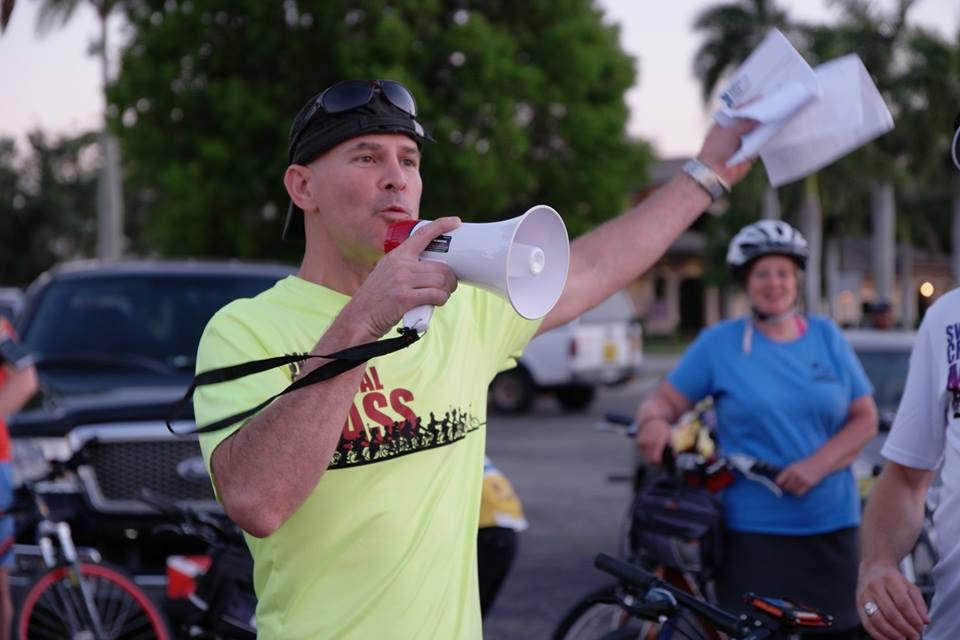
highlighter manQuirkers, a term for riders who help direct traffic for the group, keep cars aware that riders are moving through busy streets. “I saw enough examples of how they do it correctly and incorrectly,” Rob said. “We stop traffic because there are so many of us, but we are very polite about it. The bikers tend to be very well lit, but to cross McGregor and get to the other side of the street, it’s impossible to do safely one at a time. So a quirker does essentially block traffic, but at the same time they are communicating with the cars and letting them know who we are. They may even give them a Critical Mass card. We’ve had few negative comments from drivers. It’s been a real blessing.”
 
On occasion, the Fort Myers Police Department will accompany rides as well. “They’ve been a terrific help,” Rob said. “On Art Walk night, the streets tend to be busy and are no longer open to car traffic. The bike cops help us get through without incident. In addition to the Fort Myers ride, we’ve also started a ride in Cape Coral. The police there are actually on motorcycles guiding us the entire way. They embraced our group so quickly and were thrilled to take part. They bring their families. Kids can actually be at work with their dad as he helps us ride through. It’s wonderful. The community at large has a great respect for the police when they take part, because they are being a friend to the community and as cyclists we are riding more safely.”

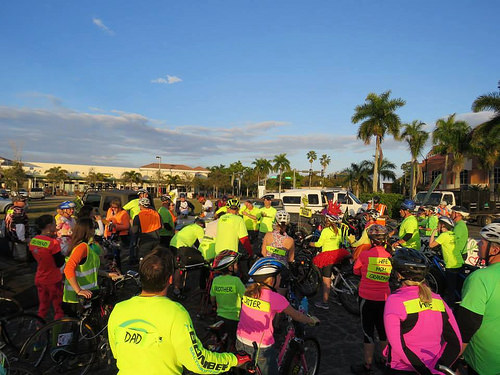
The SW Florida Critical Mass membership now tops 1,200. That doesn’t necessarily mean each rider comes to every ride, but a typical ride could include numbers ranging from 150 to 225 riders at a time, sometimes exceeding 300. Since membership has been increasing, so have the number of rides available. Starting with the Fort Myers ride, then the Cape Coral ride, members can now enjoy a NE Lee County ride which is just getting underway, and one in Sanibel that is in the making. All the rides take place during evening hours and the group encourages members to light their bikes up adequately. If you are new to CM and you find a group ride of such magnitude a little daunting, Critical Mass also offers a training ride Saturday mornings. Instruction is given to riders on the fundamentals of group riding, how to do it safely, graduating up to a larger ride.

critical mass peepsRob says SW FL Critical Mass’ main objective is to bring a solid bike culture to the area and give it a voice. Biking in a group not only promotes things like friendship, but also provides strength in numbers. Biking also tends to reach out to people in a positive way. There are those who enjoy the ride so much they eventually start their own ride. Rob says awareness of bikes on the road and having the community support biking has a way to go though. “We’ve only just begun. It amazes me that there are so few bike racks in downtown Fort Myers. It’s frustrating. When it comes to our actually being recognized and what the benefits are, it would be neat to see more action behind the words. There are many things needed for an older city to come up to modern times with safe cycling.”

Rob Seibert and SW FL Critical Mass members invite you to come out and join them for a ride! “There’s such a high energy to our rides. People are just so proud of the fact they are even part of something like this, meeting new friends they wouldn’t have otherwise. It’s part of the crux we’ve been building. Forget about your life worries, your stuff, the things of life that are challenging. This is an opportunity for no money to drop your worries, and let it all go for a little while. It’s all ages. There’s no rich, there’s no poor. There’s no white, there’s no black. There’s no politics. All your worries will be there for you when you’re done with the bike ride. Forget about your stuff for a little while and enjoy a bike ride!”

You can find out more about SW FL Critical Mass by searching them on Facebook, their main source to get information about rides out to the public. You can also find information on Craigslist, Meetup.com and Twitter. Rob says the group can be found on a number of online sites, but word of mouth and friends of friends, is what has truly helped build the group’s membership and create such a unique group of riders. 

Watch: Dan Moser on bicycling in Lee County

Interview by Craig Handel and Andrew West for the News-Press 'Cycling Hot Spots' feature.